Here & Now
An invitation to Pause, Encounter, and Grow together.

An invitation to Pause, Encounter, and Grow together.
By JULIE A. LARY
Writer.
Editor’s Note: Hanukkah is a Jewish festival commemorating the recovery of Jerusalem and subsequent rededication of the Second Temple at the beginning of the Maccabean Revoltagainst the Seleucid Empire in second century BC. —Debora Buerk, Editor.
Originally Hanukkah was celebrated without fanfare, solemning focused on lighting the menorah in rembrance of the reconsecration of the Temple in Jerusalem. It’s since evolved to include family get-togethers, gift-giving throughout the eight-night holiday, and of course, lots of food is consumed.
Every Jewish holiday, even Yom Kippur, which concludes with a “break the fast” feast, with special foods. Hanukkah is no exception.
The story of Hanukkah is told in the books of the First and Second Maccabees. When the Greek king Antiochus IV Epiphanes assumed the Greco-Syrian empire around 175 B.C.E., he wanted the Jews to assimilate. To make his point, he plundered the temple in Jerusalem, issuing a decree that all people where to serve pagan gods and cease studying Torah, observing the Sabbath, following dietary laws, and other Jewish practices.
Obviously, the decree wasn’t met with enthusiasm. When representatives of Antiochus arrived in Modi’in with the goal of reforming the Jews, Mattathias ben Johanan, a Jewish priest, along with his five sons, assembled a small army, the Maccabees, named after Mattahias’ middle son, Judah Maccabee, a brilliant military strategist.
Upon declaring victory, the Maccabees entered the desecrated temple to worship, discovering there was only enough oil to light the menorah for a day. The oil, however, miraculously burned for eight days.
So began the festival of the lights—Hanukkah is celebrated for eight days, starting on the twenty-fifth day of Kislev, the ninth month of the Jewish calendar. We feast on potato pancakes (latkes) and donuts (sufganiyot) are fried in oil, brisket, roast chicken, or brisket with dried fruits are served with baked noodles (kugel). Children sing songs and spin dreidels, hoping to win chocolate coins (gelt).
Candlelight is especially meaningful in Judaism. Right before sundown, every Friday night with the onset of the Sabbath candles are lit. The candles represent the spiritual light that enters homes and hearts on the Sabbath and the world through the study of Torah. Sarah lit the first Sabbath candles in the tent she shared with Abraham. The flickering flame on that night and subsequent nights, in millions of Jewish households, over the centuries, illuminated the dark.
Darkness isn’t normally something I typically experience with the ability to turn on a light with the flip of a switch.
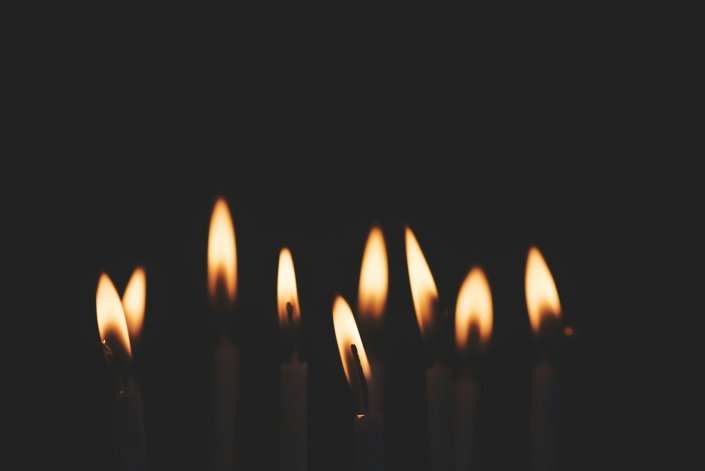
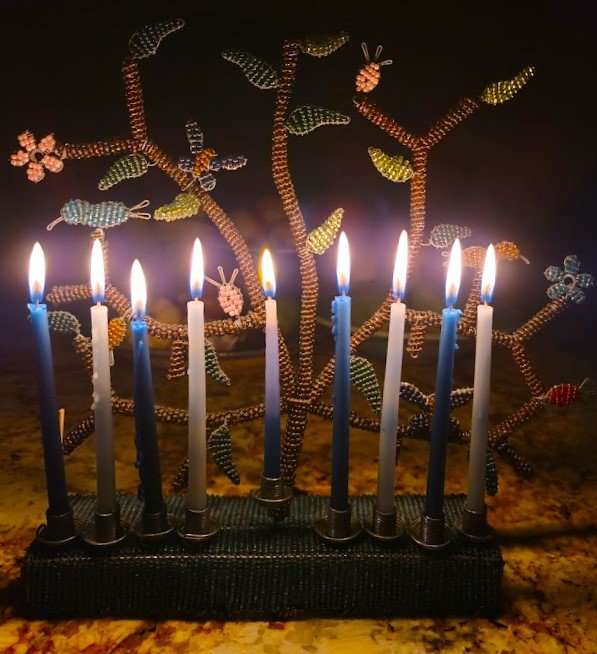
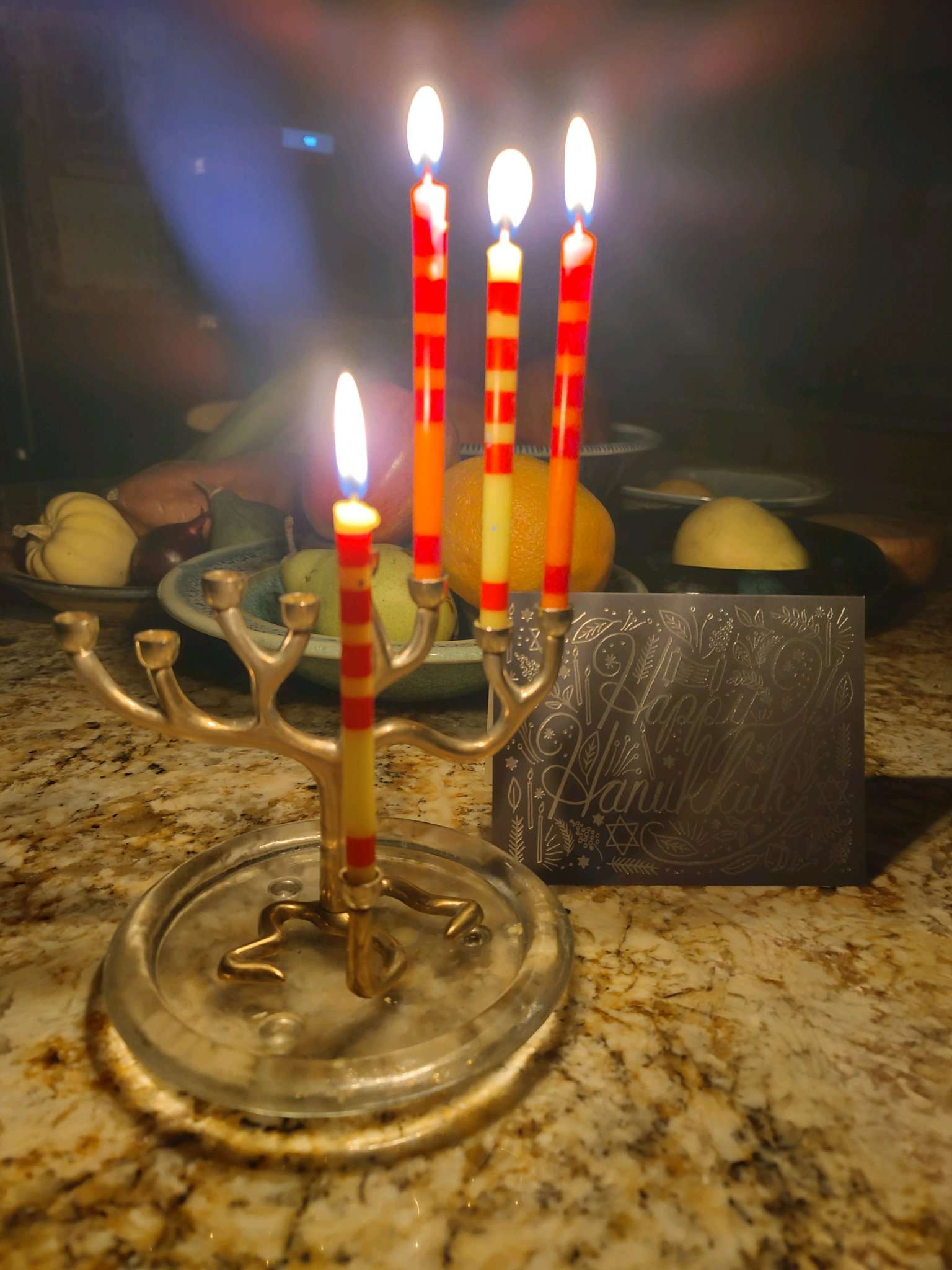
The Hanukkah menorah provides an opportunity to darken a room, and I delight in the simplicity of a dancing flame, which becomes brighter with each night, until nine candles are lit, creating a mesmerizing sashay of light and reminding me, no matter how dark it is outside, a candle of Godly goodness can transform the darkness.

T
T
T
Leave a Reply
Want to join the discussion?Feel free to contribute!